new

Get trending papers in your email inbox!

Subscribe

Trending Papers

byAK and the research community

Trending Papers

PaperOrchestra: A Multi-Agent Framework for Automated AI Research Paper Writing

PaperOrchestra is a multi-agent framework that converts unstructured research materials into complete LaTeX manuscripts with literature synthesis and visual elements, outperforming existing autonomous writing systems in human evaluations.

  • 4 authors

· Apr 6, 2026
Submitted by
ruiyaox

Harness^2: Recursive Agent Harnessing for an Open World

Harness² improves agent execution harnesses through recursive task-level refinement and continual harness-level learning, boosting performance across benchmarks without ground-truth verifiers.

google Google · Oct 9, 2026
Submitted by
Cloudriver

OS-Omni: Benchmarking Generalist Computer-Using Agents on Long-Horizon Workflows Across Platforms

A live cross-platform benchmark evaluates computer-using agents on long-horizon workflows across Windows, Ubuntu, macOS, iOS, Android, and Web, showing that current agents remain far from platform-robust computer use and trail humans on iOS and macOS.

touchstone-ai Touchstone AI · Nov 25, 2026
Submitted by
taesiri

Unlimited OCR Works

Unlimited OCR introduces Reference Sliding Window Attention to eliminate growing memory consumption during long-sequence OCR tasks, enabling efficient transcription of multiple pages in a single forward pass.

baidu BAIDU · Jun 22, 2026

TradingAgents: Multi-Agents LLM Financial Trading Framework

A multi-agent framework using large language models for stock trading simulates real-world trading firms, improving performance metrics like cumulative returns and Sharpe ratio.

  • 4 authors
· Dec 28, 2024
Submitted by
akhaliq

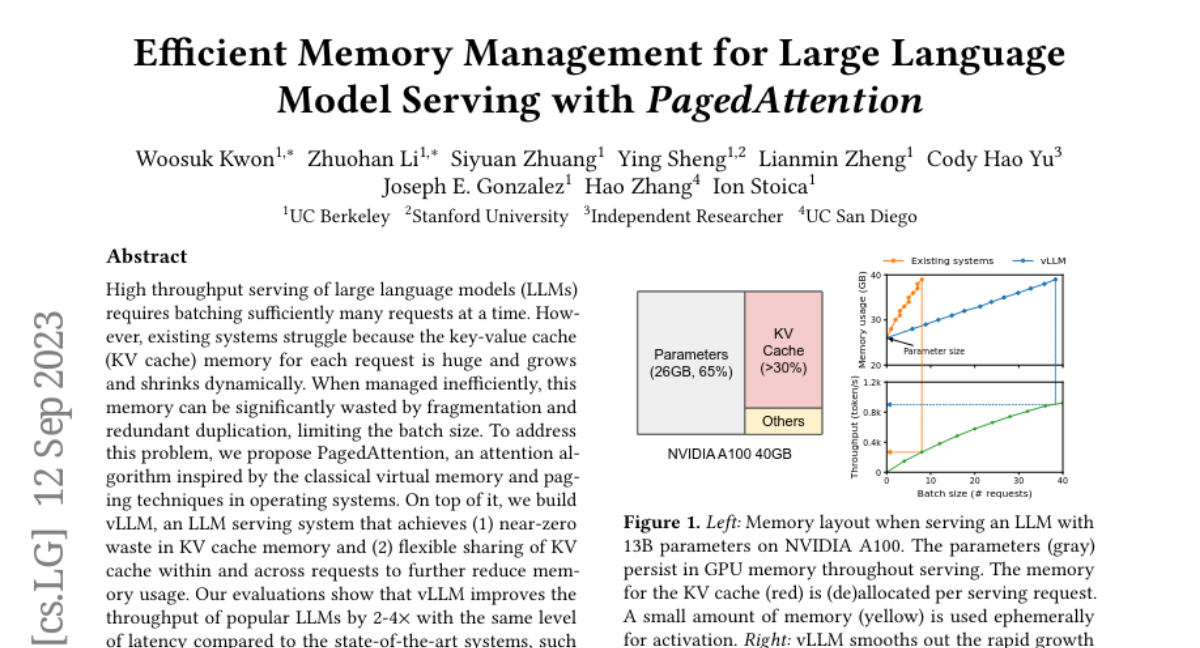
Efficient Memory Management for Large Language Model Serving with PagedAttention

PagedAttention algorithm and vLLM system enhance the throughput of large language models by efficiently managing memory and reducing waste in the key-value cache.

  • 9 authors
· Sep 12, 2023
Submitted by
csjiaya

InCoder-32B: Code Foundation Model for Industrial Scenarios

InCoder-32B is a 32-billion-parameter code model trained on industrial datasets with extended context length and execution verification to improve performance in hardware-aware programming tasks.

Beihang Beihang University · Mar 17, 2026
Submitted by
akhaliq

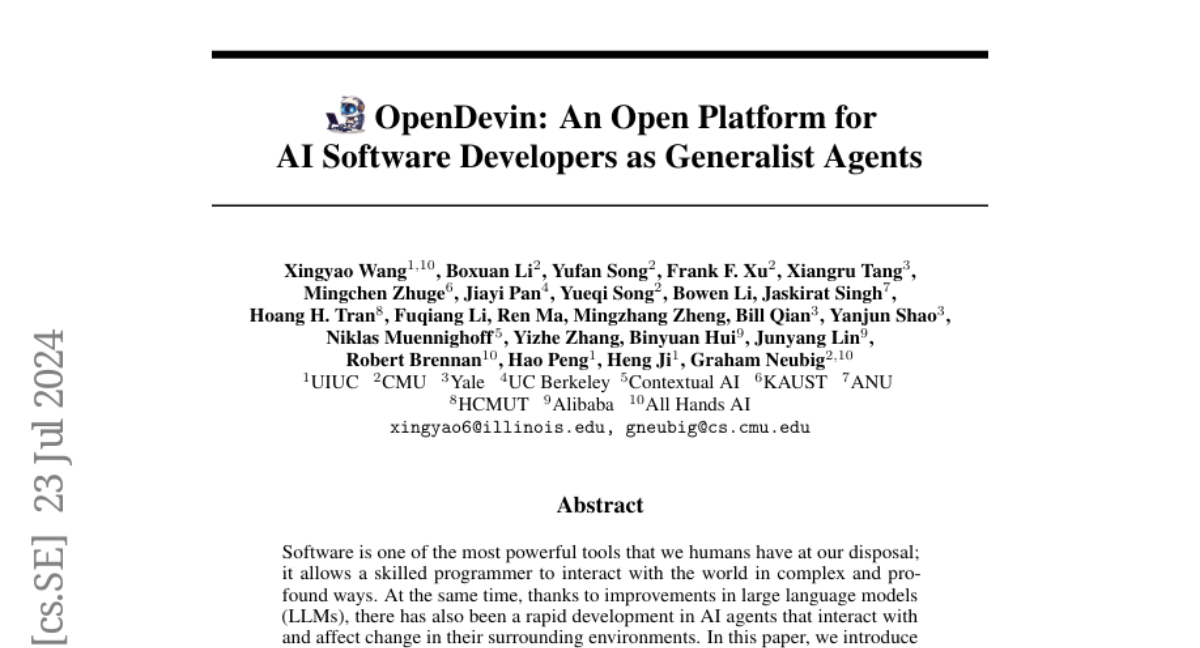
OpenDevin: An Open Platform for AI Software Developers as Generalist Agents

OpenDevin is a platform for developing AI agents that interact with the world by writing code, using command lines, and browsing the web, with support for multiple agents and evaluation benchmarks.

  • 24 authors
· Jul 23, 2024
Submitted by
RuofengYang

ARIS: Autonomous Research via Adversarial Multi-Agent Collaboration

ARIS is an open-source research harness that uses cross-model adversarial collaboration to ensure reliable long-term research outcomes through coordinated execution, orchestration, and assurance layers.

Submitted by
iTheresaApocalypse

Gamer: A Generalist Vision-Language-Action Foundation Model for Long-Horizon Real-Time Game Agent

Gamer is a generalist agent framework that integrates perception, memory, and multi-step reasoning, trained through continued pre-training, sparse-thinking instruction tuning, and multi-turn reinforcement learning to interact efficiently in 2D and 3D environments.

  • 27 authors
· Nov 13, 2026
Submitted by
amael-apple

Depth Pro 2: Sharp and Temporally Consistent Metric Monocular Depth

A single scalable network estimates dense metric depth for images and video at native resolution, jointly improving metric accuracy, boundary sharpness, and temporal consistency.

apple Apple · Nov 19, 2026
Submitted by
ChengCui

PaddleOCR-VL-1.6: Expanding the Frontier of Document Parsing with Under-Optimized Region Refinement and Progressive Post-Training

PaddleOCR-VL-1.6 enhances document parsing performance through targeted data optimization and progressive post-training techniques, achieving state-of-the-art results on OmniDocBench v1.6.

PaddlePaddle PaddlePaddle · Jun 2, 2026
Submitted by
akhaliq

Very Large-Scale Multi-Agent Simulation in AgentScope

Enhancements to the AgentScope platform improve scalability, efficiency, and ease of use for large-scale multi-agent simulations through distributed mechanisms, flexible environments, and user-friendly tools.

  • 8 authors

· Jul 25, 2024
Submitted by
taesiri

AgentScope 1.0: A Developer-Centric Framework for Building Agentic Applications

AgentScope enhances agentic applications by providing flexible tool-based interactions, unified interfaces, and advanced infrastructure based on the ReAct paradigm, supporting efficient and safe development and deployment.

  • 23 authors
· Aug 22, 2025
Submitted by
taesiri

MinerU2.5: A Decoupled Vision-Language Model for Efficient High-Resolution Document Parsing

MinerU2.5, a 1.2B-parameter document parsing vision-language model, achieves state-of-the-art recognition accuracy with computational efficiency through a coarse-to-fine parsing strategy.

  • 61 authors

· Sep 26, 2025
Submitted by
aaronjli

TokenEconomizer: Experience-Driven Black-Box Cost Control for Coding Agents

TokenEconomizer reduces recurring token costs of coding agents across sequential real-world tasks by pruning irrelevant tools, injecting micro-skills, and interrupting failure loops.

MicrosoftResearch Microsoft Research · Oct 15, 2026
Submitted by
akhaliq

Instruction-Following Evaluation for Large Language Models

Instruction-Following Eval (IFEval) provides a standardized benchmark for evaluating Large Language Models' ability to follow natural language instructions using verifiable criteria.

  • 8 authors

· Nov 14, 2023
Submitted by
andito

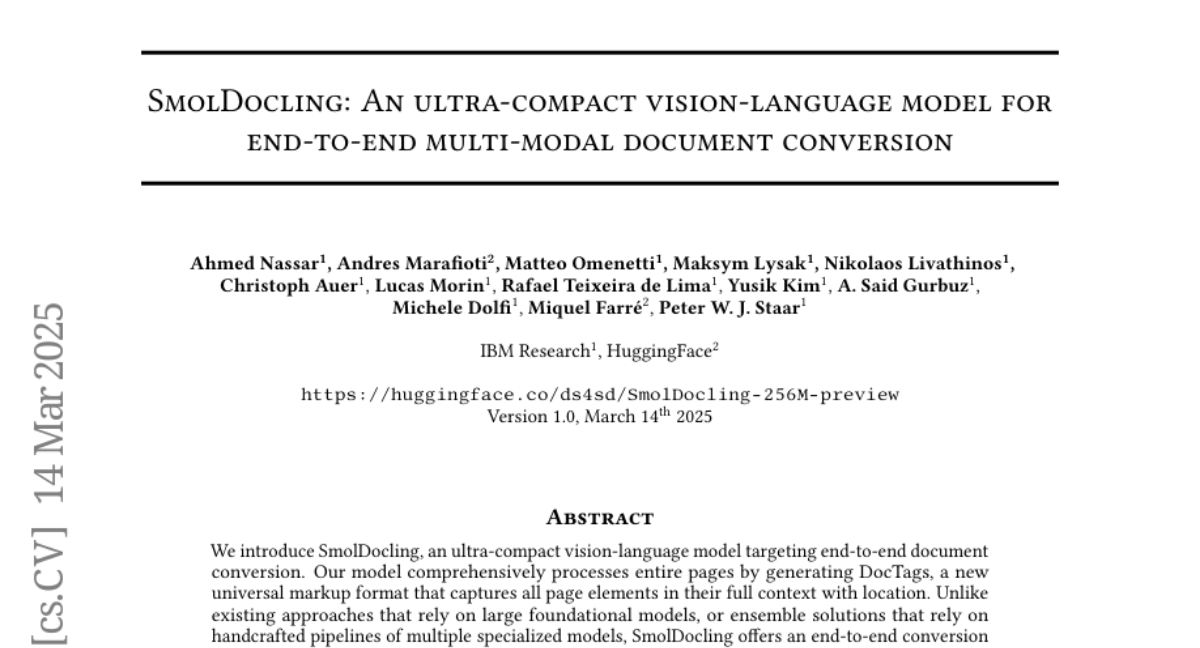
SmolDocling: An ultra-compact vision-language model for end-to-end multi-modal document conversion

SmolDocling is a compact vision-language model that performs end-to-end document conversion with robust performance across various document types using 256M parameters and a new markup format.

ibm-granite IBM Granite · Mar 14, 2025
Submitted by
caizhongang

Has GPT-6-Astra Achieved Embodied Intelligence?

GPT-6-Astra achieves high performance across diverse robotic tasks via in-context learning, yet real-world deployment reveals gaps in demonstration cost, execution time, and practical embodied intelligence.

sensenova SenseNova · Oct 15, 2026
Submitted by
akhaliq

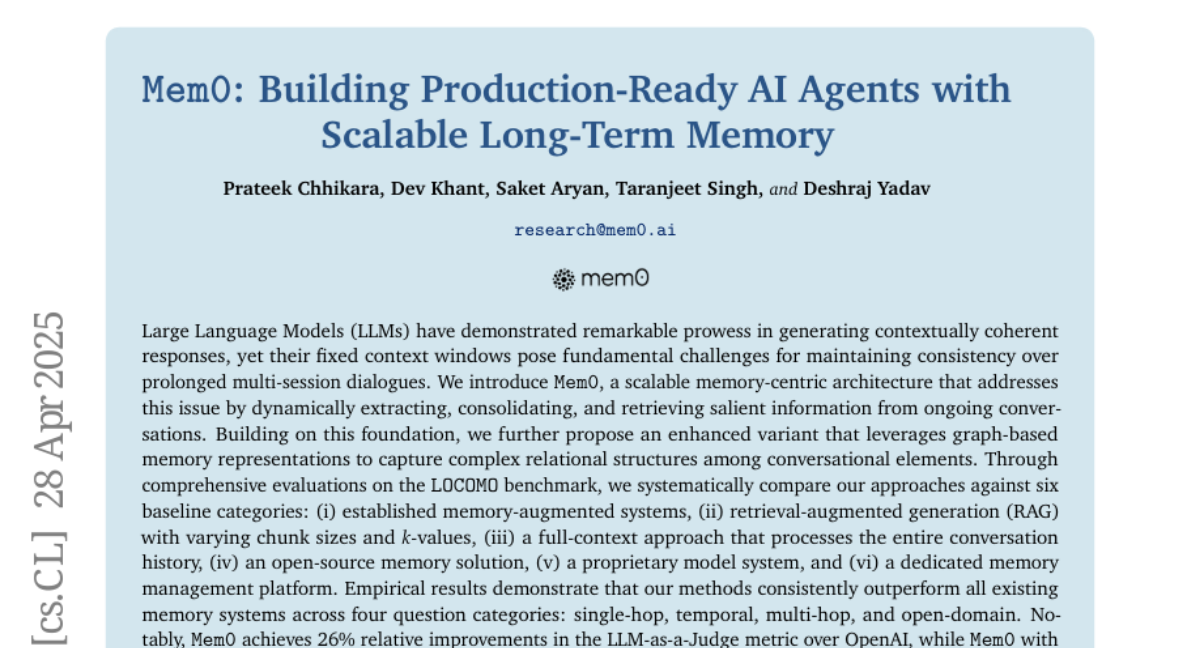
Mem0: Building Production-Ready AI Agents with Scalable Long-Term Memory

Mem0, a memory-centric architecture with graph-based memory, enhances long-term conversational coherence in LLMs by efficiently extracting, consolidating, and retrieving information, outperforming existing memory systems in terms of accuracy and computational efficiency.

  • 5 authors
· Apr 28, 2025
Submitted by
csuhan

OpenGame: Open Agentic Coding for Games

OpenGame is an open-source agentic framework for end-to-end web game creation that uses specialized code models and evaluation benchmarks to overcome challenges in interactive application development.

  • 11 authors
· Apr 20, 2026
Submitted by
LianghuiZhu

Mixture-of-Loops Transformer

A Mixture-of-Loops Transformer reuses key-value memory across loops and depths, and its U-shaped variant improves pretraining efficiency and inference latency.

ByteDance-Seed ByteDance Seed · Nov 25, 2026
Submitted by
nielsr

Geometric Context Transformer for Streaming 3D Reconstruction

LingBot-Map is a feed-forward 3D foundation model that reconstructs scenes from video streams using a geometric context transformer architecture with specialized attention mechanisms for coordinate grounding, dense geometric cues, and long-range drift correction, achieving stable real-time performance at 20 FPS.

robbyant Robbyant · Apr 15, 2026

LittleBit: Ultra Low-Bit Quantization via Latent Factorization

LittleBit is a novel method for extreme compression of large language models using low-rank factorization and multi-scale compensation, achieving significant memory reduction and performance in sub-1-bit quantization.

  • 4 authors
· May 30, 2025
Submitted by
draven-alg

Embo-Harness: Towards Understanding Frontier-Model-as-Policy Harness

A systematic framework shows that frontier multimodal models can serve as robot policies when harnessed with interfaces favoring native visual reasoning and tool use, achieving high success in simulated and real manipulation tasks.

mmlab-ntu MMLab@NTU · Nov 23, 2026

A decoder-only foundation model for time-series forecasting

A large language model adapted for time-series forecasting achieves near-optimal zero-shot performance on diverse datasets across different time scales and granularities.

  • 4 authors
· Oct 14, 2023
Submitted by
Rbin

RAG-Anything: All-in-One RAG Framework

RAG-Anything is a unified framework that enhances multimodal knowledge retrieval by integrating cross-modal relationships and semantic matching, outperforming existing methods on complex benchmarks.

One Model to Rig Them All: Diverse Skeleton Rigging with UniRig

UniRig is a framework using autoregressive models and cross-attention for automated skeletal rigging, achieving high accuracy across diverse 3D models.

  • 5 authors
· Apr 16, 2025
Submitted by
ThreeSR

ToolSmith: An Automatic Tool-Generation Framework for Multimodal Search Agents

Recent multimodal search agents use reasoning, vision, and live web search across many turns to answer questions beyond parametric knowledge by orchestrating a small library of hand-crafted search and visual tools. However, the library is laborious to create and maintain, and frozen when new query types, evidence formats, and failure modes are encountered in the wild. Human practitioners, by contrast, cope with insufficient tools by fashioning new ones from familiar parts and reusing them across tasks. Inspired by this, we propose ToolSmith, an automatic tool-generation framework that grows and reuses modules on top of a lean base tool library. We evaluate ToolSmith on three in-domain multimodal search benchmarks and ten out-of-domain benchmarks under a VLM-as-a-Judge protocol. ToolSmith consistently improves over the base library across deployed agents of varying scales, with larger backbones reaping greater gains, demonstrating the scalability of the approach. Our code and data are available at https://threesr.github.io/toolsmith/.

uclanlp UCLA NLP · Nov 23, 2026

OmniFlatten: An End-to-end GPT Model for Seamless Voice Conversation

A novel GPT-based model, OmniFlatten, enables real-time natural full-duplex spoken dialogue through a multi-stage post-training technique that integrates speech and text without altering the original model's architecture.

  • 9 authors
· Oct 23, 2024

Kronos: A Foundation Model for the Language of Financial Markets

Kronos, a specialized pre-training framework for financial K-line data, outperforms existing models in forecasting and synthetic data generation through a unique tokenizer and autoregressive pre-training on a large dataset.

  • 7 authors

· Aug 2, 2025
Submitted by
WhiteYC

High-Fidelity Image Matting with Pixel-Space Diffusion Transformers

Diffusion models have shown strong potential for image matting by transferring generative priors learned from large-scale pretraining. However, existing approaches largely rely on latent diffusion models, whose compressed representations and VAE-based reconstruction introduce a mismatch with the high-frequency precision required for matting. We present PixelMatte, a framework that adapts pretrained pixel-space diffusion transformers for high-fidelity image matting. We show that strong image-conditioned matting capabilities can be acquired even from a pure text-to-image model without paired image-to-image pretraining. Our approach reuses the backbone's native patch embedding to jointly process the input image, trimap, and noisy alpha matte as spatially aligned tokens, enabling direct pixel-space prediction without additional condition encoders or adapters. With pixel-accurate synthetic supervision and real-image fine-tuning, PixelMatte predicts alpha mattes in a single forward pass. Two lightweight calibration modules, LayerShift and High-Pass Refiner, further improve regional opacity accuracy and boundary fidelity. Experiments across four benchmarks and two distinct pixel diffusion backbones demonstrate substantial improvements over existing methods, reducing SAD and gradient errors by 24-44% relative to RenderMatte on P3M-500-NP and AM-2K, while achieving competitive performance on AIM-500 and RenderMatte-2K. These results demonstrate the effectiveness of pixel-space generative priors for precision-sensitive image matting. Project page: https://white-yc.github.io/pixelmatte/.

  • 8 authors
· Nov 25, 2026
Submitted by
sanaka87

Improving and Expanding Video Editing Capabilities Without Videos

Image-to-Video Transfer improves pretrained video editors by training them as image editors on single images, enabling new video editing tasks and state-of-the-art results on OpenVE-Bench and OpenVE++.

Bitnet.cpp: Efficient Edge Inference for Ternary LLMs

Bitnet.cpp enhances edge inference for ternary LLMs using a novel mixed-precision matrix multiplication library, achieving significant speed improvements over baselines.

  • 10 authors
· Feb 17, 2025
Submitted by
andy-yang

FreeToken: Efficient Edge-Native MoE Serving with Bandwidth-Adaptive Execution

FreeToken is an edge-native Mixture-of-Experts serving system that dynamically maps computation and model state onto heterogeneous local hardware to run large open-weight models on personal machines.

PDFMathTranslate: Scientific Document Translation Preserving Layouts

PDFMathTranslate enables layout-preserving scientific document translation using large language models and precise layout detection, offering improved precision, flexibility, and efficiency.

  • 4 authors
· Jul 2, 2025

Zep: A Temporal Knowledge Graph Architecture for Agent Memory

Zep, a memory layer service, outperforms MemGPT in the DMR benchmark and LongMemEval by excelling in dynamic knowledge integration and temporal reasoning, critical for enterprise use cases.

  • 5 authors
· Jan 20, 2025
Submitted by
yunyangge

MovieRoll: A Systematic Framework for Rolling Out Long-Form Videos

Streaming video generation must sustain quality beyond the training horizon while handling self-generated history and growing cache costs. To address these challenges, we present MovieRoll, a base-to-distilled framework that connects streaming fine-tuning, long-rollout distillation, and long-horizon inference. We first establish a robust multi-step base through Window-wise Teacher Forcing (WinTF), which jointly denoises chunks at progressive noise levels with bidirectional attention within each window and causal access to preceding history. To retain historical context efficiently, hierarchical KV-cache compression (HieraKV) exploits layer-wise attention patterns, retaining full history in shallow layers and sink--recent history in deeper layers. This reduces cache memory by up to 78% while improving generation quality. Building on this base, cumulative long tuning with distribution matching distillation (CuLT-DMD) holds parameters fixed throughout each long self-rollout and averages local gradients before updating. Each update therefore combines supervision across temporal positions while retaining only one local computation graph, enabling efficient long-rollout training of a few-step generator. To extend generation beyond the training horizon, KV recomputation bounds context for both models, while guidance annealing (AnnealCFG) reduces guidance toward the clean endpoint to stabilize MovieRoll-Base. Complementing these modeling advances, FBCA attention and PS-VAE decoding support efficient training and streaming output. On HeliosBench, MovieRoll-Base remains competitive at 30s after training on videos of up to 15s, and MovieRoll-Distilled achieves the highest total scores among the compared methods across single- and multi-event evaluations up to 60s, combining sustained naturalness with active motion.

  • 12 authors
· Nov 16, 2026
Submitted by
taesiri

Qwen3-TTS Technical Report

The Qwen3-TTS series presents advanced multilingual text-to-speech models with voice cloning and controllable speech generation capabilities, utilizing dual-track LM architecture and specialized speech tokenizers for efficient streaming synthesis.

Qwen Qwen · Jan 22, 2026
Submitted by
lhpku20010120

OmniEdu: Open Foundation Models for Learning and Teaching

OmniEdu is a family of instruction-tuned educational foundation models that improve K-12 problem solving, curriculum understanding, and tutoring through capability-balanced training data.

PekingUniversity Peking University · Sep 19, 2026
Submitted by
taesiri

SkillOpt: Executive Strategy for Self-Evolving Agent Skills

SkillOpt introduces a systematic text-space optimizer for agent skills that trains skills as external agent state with stable updates and zero deployment inference overhead, achieving superior performance across multiple benchmarks and execution environments.

MicrosoftResearch Microsoft Research · May 22, 2026

LoopTitan: What Does Parameter Revisit Buy a Mixture-of-Experts?

Parameter revisit in looped Mixture-of-Experts provides little intrinsic benefit; observed gains stem mainly from network shape, residual scaling/optimizer effects, and added compute, motivating LoopTitan-Base as a stronger standard MoE baseline.

NaturalScale Natural Scale · Nov 25, 2026
Submitted by
amael-apple

Sharp Monocular View Synthesis in Less Than a Second

SHARP synthesizes photorealistic views from a single image using a 3D Gaussian representation, achieving state-of-the-art results with rapid processing.

apple Apple · Dec 11, 2025
Submitted by
cheese1

Code World Model 2.0: Towards Infinite Controllable Video Generation

Visual proxies decouple explicit world-state simulation from photorealistic video synthesis, offering a controllable interface for both offline clip creation and real-time interactive streaming. Yet a practical renderer must address two challenges. Upstream proxies vary from coarse layouts to fine articulated geometry depending on the interaction, and streaming inference must operate in a few causal steps without accumulating drift across self-generated history. We present Invoker-Render, pairing a bidirectional creation model with a causal four-step streaming model under a shared conditioning interface over structural proxies, an appearance reference, and language. Trained on an aligned approximately 200-hour multi-granularity corpus, Invoker-Render honors fine geometric constraints when supplied while synthesizing plausible local motion under coarse proxies, enabling runtime selection of input detail. To bridge bidirectional creation and real-time streaming without compounding step compression and rollout drift, we introduce Progressive Forcing (ProForcing). ProForcing first trains a causal predictor and distills it into a four-step renderer using histories derived from training videos. Training then shifts to continuous self-generated rollouts. A pipelined serving stack supports efficient streaming inference. Experiments show versatile control across proxy families, granularities, and camera paths, consistent gains over recent streaming baselines, and stable 30-minute racing rollouts that preserve scene and subject appearance.

inclusionAI inclusionAI · Nov 17, 2026
Submitted by
nielsr

Ultralytics YOLO26: Unified Real-Time End-to-End Vision Models

YOLO26 addresses real-time vision challenges through a unified model family with NMS-free inference, improved training strategies, and multi-task capabilities spanning detection, segmentation, and pose estimation.

Ultralytics Ultralytics · Jun 2, 2026
Submitted by
guanwenhao

VoxMel TTS Technical Report

VoxMel is a tokenizer-free autoregressive TTS framework that uses an invertible two-axis Haar transform to decompose mel spectrograms into Coarse-Mel and residual tiers, enabling stable high-fidelity generation with strong recognition and speaker-similarity results.

VoxDance-Lab VoxDance-Lab · Nov 15, 2026
Submitted by
Zonghao2025

Securing the AI Agent: A Unified Framework for Multi-Layer Agent Red Teaming

AI-Infra-Guard is an open-source framework that addresses AI infrastructure security through layered detection paradigms spanning infrastructure, protocol, agent behavior, and model layers.

tencent Tencent · Jun 30, 2026

Native and Compact Structured Latents for 3D Generation

A new sparse voxel representation called O-Voxel enables high-quality 3D generative modeling with efficient inference and robust topology handling.

microsoft Microsoft · Dec 16, 2025
Submitted by
unilm

VibeVoice Technical Report

VibeVoice synthesizes long-form multi-speaker speech using next-token diffusion and a highly efficient continuous speech tokenizer, achieving superior performance and fidelity.

MicrosoftResearch Microsoft Research · Aug 26, 2025
Submitted by
ghy0324

π^4: A Foundation Model for 4D Scene Geometry and Motion

This unified foundation model enables the recovery of dense geometry, camera poses, and object tracking from diverse, uncalibrated observations in 4D scenes using a shared geometry and motion branch architecture.

Shanghai-AI-Laboratory Shanghai AI Laboratory · Nov 17, 2026